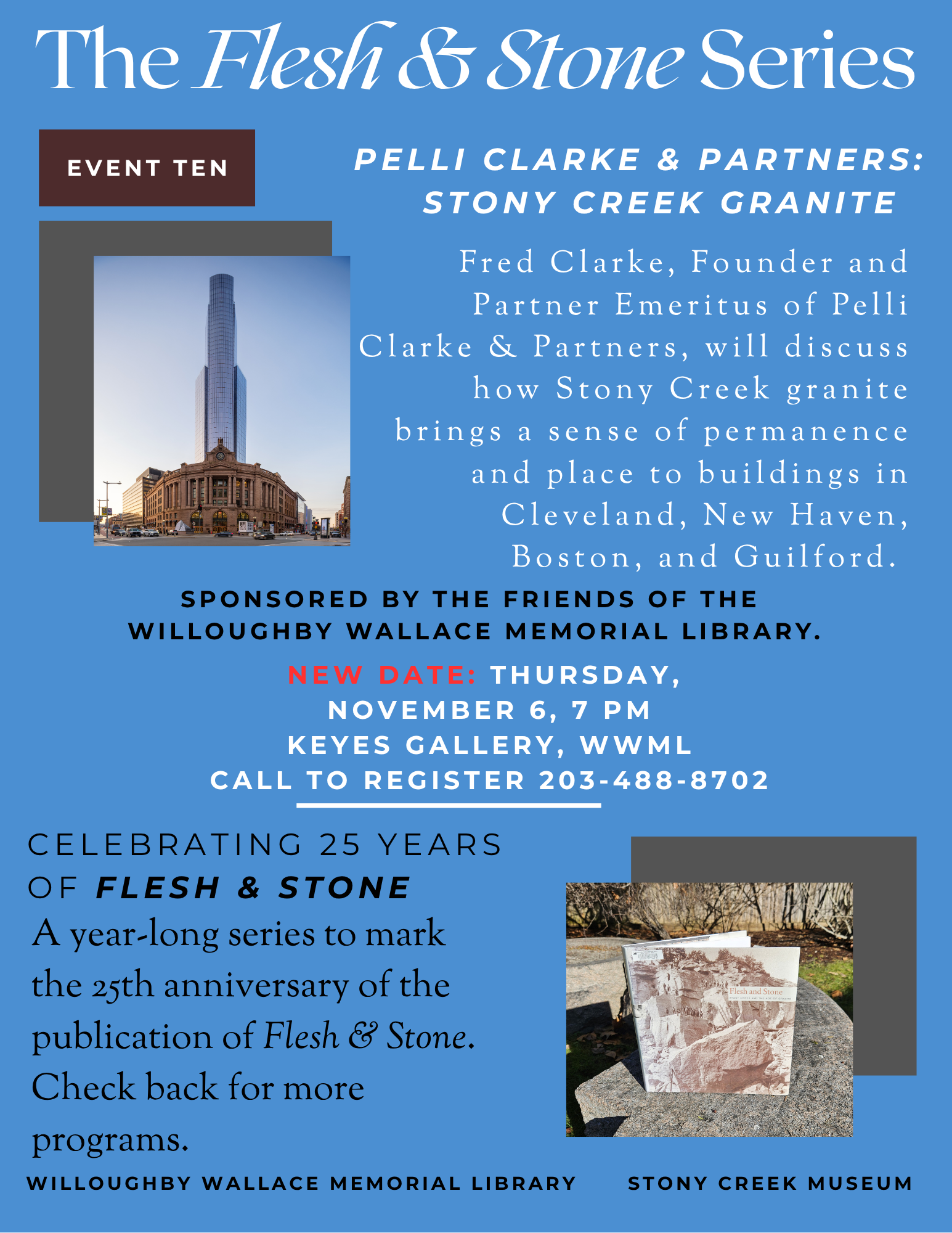
Stony Creek Local History
Local History Collection

Welcome to the Willoughby Wallace Memorial Library Local History Collection.
The mission of the Local History Collection is to document the history of the library, local area, and the people of Stony Creek.
Books, photographs, documents, ephemera, newspaper clippings, magazine articles, and art work comprise the collection. Though the collection focuses on Stony Creek, it also has books about the towns of Branford and Guilford, as well as New Haven County. Popular Stony Creek topics include the Thimble Islands, the theater, the granite quarry, and the hurricane of ’38.
The collection is accessible Thursday afternoons and by appointment.
Many of the photographs are available for viewing on Instagram @wwmlibrary
Please direct your local history collection questions to Thia Wrightsman, twrightsman@wwml.org. Thank you for your patience while awaiting a reply.
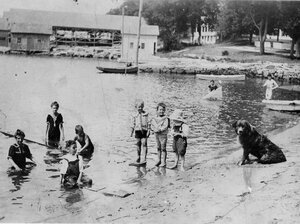


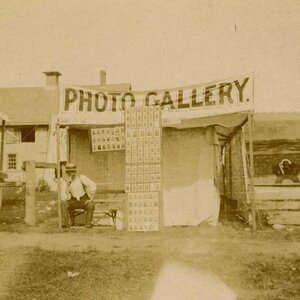


Stony Creek Timeline
Pre-European Settlement
Native Americans including a branch of the Mattabesecs, Mohegans, Narragansetts, and Pequots summered in Stony Creek and the Thimble Islands and may have wintered in a cave nearby.
1614
Adrian Block, a Dutchman, was the first European explorer to find the Thimble Islands.
1638
The New Haven Colony traded "eleven coats of trucking cloth and one coat of English cloth made in the English fashion" to the Mattabesec Indians for the land known as Totokett.
1644
A group from Wethersfield settled in Totokett, the Mattabesec term for "tidal river" which referred to the Branford area.
1698
The pirate, Captain Kidd, was rumored to have stopped in the Thimble Islands for provisions and to bury treasure.
1710
The first road was built into Stony Creek.
1739
The Thimble Islands were deeded to Isaac Cook.
1750
Connecticut legislature made it lawful for towns to make by-laws regulating shell fishing.
1788
The Stony Creek School District was established.
1846
The first island home was built on Pot Island.
1852
Benjamin Green opened the first quarry in Stony Creek on West Point Rd.
1852
The Shoreline Railroad began service to Stony Creek.
1852
The first Post Office opened.
1854
Tourism began.
1862
The Granite Island Quarry opened on Roger's Island.
1864
James Blackstone sold Money Island to Chauncey A. Dickerman.
1866
Union Chapel, a nondenominational church, opened at 128 Thimble Islands Rd.
1866
Money and Governor's Island lots were sold.
1868
The Stony Creek Oyster Company organized.
1870s
Allen Dickerman of New Haven sold lots on Money Island for summer cottages.
1870
Chandler Wayland purchased Little Pumpkin Island.
1870
Thomas Pearson of New York purchased Goat Island (aka Bear Island) and quarried rock for bridges across the Connecticut River at Old Saybrook, Middletown, and Hartford.
1870
The Pine Orchard Quarry at Juniper Point, west of Stony Creek, opened. It supplied paving stones for New York City.
1874
A Shoreline train fell from a bridge in Stony Creek, killing Superintendent W. M. Wilcox.
1874
The Connecticut Granite Company opened north of the center of Stony Creek to supply granite to the Metropolitan Museum of Art in New York City. The quarry also provided granite to the Hartford and Albany statehouses. The business was later renamed the Red Hill Quarry and the Stony Creek Red Granite Quarry.
1878
William Judson Clark of Southington, Connecticut, one of the founders of Clark Brothers Company that manufactured nuts and bolts, etc., commissioned architect Henry Austin to design him a home on Prospect Hill. Austin designed a stick-style Victorian home that is now on the National Register of Historic Places.
1880
The steamer, Ivernia, under charge of Capt. Nelson Frisbie, toured Stony Creek and the Thimble Islands, leaving from Fair Haven in the morning.
1880
The Pot Island Hotel was operated by William H. Barnes with a bowling alley and an observatory to oversee the Thimble Islands.
1882
Norcross established a quarry in Stony Creek.
1882
Isaac C. Lewis, of Meriden, Connecticut, manufacturer of silver products, hired architect Henry Martin Jones, a Meriden architect, to design a Victorian cottage by the sea.
1883
Brainerd's General Store opened.
1885
Seaside Hall was a popular skating rink.
1885
The Stony Creek School opened on Hall's Point Road.
1886
The Stony Creek Fife and Drum Corps was founded.
1886
Beattie's Quarries at Leetes Island in Guilford supplied the granite for the pedestal of the Statue of Liberty.
1887
Norcross Brothers opened a large quarry in Stony Creek just north of the village.
1887
Stony Creek had a population of 330.
1890s
The steamer, Margaret, captained by Charles Hill, carried tourists from New Haven to the Thimble Islands.
1890s
Hotels such as Brainerd's, Frink's, Barnes, the Flying Point House, and Northrop's entertained visitors.
1891
Carolina Lazzari was born. Her father worked in construction and in the quarries. Later, she would go on to study opera in Milan, Italy.
1892
The Stony Creek School moved to a larger building on School Street.
1892
Battle Monument, constructed with Stony Creek granite, was erected at West Point.
1894
Money Island Chapel was built.
1897
The Odd Fellows Lodge was founded, and met at Seaside Hall.
1897
A branch of the Blackstone Library opened in Stony Creek, across the street from where the Willoughby Wallace Memorial Library is now located.
1899
Boston's South Station was constructed with Stony Creek granite by Norcross Bros.
1900
The Hook and Ladder Co. No. 2, staffed by quarrymen, was replaced by the Stony Creek Rescue Company No. 5 with headquarters on School St.
1900
The Norcross Brothers quarry employed 200 men.
1900
Stony Creek's population was 1,395 residents.
1900
Fire destroyed Charley Gilley's shoe store, the barbershop, and Union Chapel located at Thimble Islands Rd. between Rextile and Ridge Roads.
1901
The Congregational Church was constructed with Stony Creek granite.
1902
Captain John Jay Phelps bought Roger's Island and renamed it Yonkomis Island.
1903
Work began on Phelp's Tudor mansion on Roger's Island.
1907
The Cemetery Association was founded.
1909
Stony Creek Association was incorporated.
1910
Electric street lights were installed.
1910
The Shore Line Electric Railway Company extended the trolley from Stony Creek to New Haven.
1911
Billie Barnes sold Pot Island to a New York Church that transported women and children to the island for summers away from the city.
1913
Stony Creek granite was incorporated in the edifice from street level to the upper roadway balustrade of Grand Central Terminal in New York City.
1914
William Howd opened a silent picture movie theater in the building that now houses the Legacy Theatre.
1917
Isaac C. Lewis Cottage was relocated away from the water.
1918
Carolina Lazzari was a contralto singer for the Chicago Opera Company.
1920
Carolina Lazzari played Amneris in Aida at the Metropolitan Opera.
1923
Dodds Granite Company purchased the Norcross Brothers quarry and operated it until 1929.
1924
E.S. Ball Oyster business started.
1925
St. Therese Catholic Parish formed in Stony Creek and met at St. Georges Hall, located on School Street.
1927
St. Therese built a new church at 84 Thimble Islands Rd.
1928
The Parish Players incorporated and began producing plays at the Stony Creek Theatre during the summers.
1930
Artist André Smith built his house and studio in Stony Creek. Smith’s personal assistant was Attilio “Duke” Banca. Smith designed some scenery for the Parish Players.
1931
The town of Branford voted to enlarge the public dock in Stony Creek.
1936
Ayn Rand's husband, Frank O'Connor, acted in her play, "The Night of January 16th" with the Broadway players at the Stony Creek Theatre while she wrote Anthem (published in 1938).
1937
Frank O'Connor returned for the summer to act with the Broadway players while Rand continued to work on her book.
1937
Bus service replaced the trolley between Branford and Stony Creek.
1937
André Smith founded the Research Studio in Maitland, Florida, an art colony that hosted prominent artists. He began dividing his time between Maitland and Stony Creek.
1938
In August, Orson Welles directed the play, “Too Much Johnson,” an 1894 play by William Gillette, at the Stony Creek Theatre. Welles also directed the film the same year.
1938
On September 21, an unexpected hurricane devastated the coasts of Connecticut and Rhode Island. It flooded Stony Creek, destroyed homes, boats, and two islanders lost their lives.
1941
Author Sinclair Lewis, acted in Stony Creek Theatre's production of "My Dear Children." He also directed Jack Levin's "The Good Neighbor" and his own play, "Angela is Twenty-Two."
1941
Douglas Orr designed his International style home on Prospect Hill.
1942
The U.S. entered World War II and the theatre became a factory to manufacture parachutes.
1946
Willoughby Wallace, a Stony Creek resident, left a trust to fund the construction of a library in Stony Creek.
1946
Materna-Line, Inc., manufacturer of corsets and women's undergarments, operated in the former theatre building.
1952
A fire on Leete's Island Rd., at Mrs. Collins' convalescent home, spread quickly, killing three occupants of the home and one woman who lived nearby who experienced a heart attack.
1955
Lester Hill built a 26-foot steamboat, the Zephyr, in his front yard and lowered it into the water at Ball's Oyster dock.
1955
Castellucci Brothers purchased the Dodd's Granite Company quarry.
1957
The artist Susan Weil, commissioned Bernard Kirschenbaum to create a geodesic dome for her art studio in the woods of Stony Creek.
1958
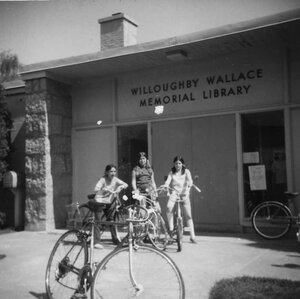
The Willoughby Wallace Memorial Library opened. Architect Douglas Orr donated his services to design the building. The Castellucci Brothers donated Stony Creek pink granite.
1959
The Connecticut Turnpike opened.
1959
Artist André Smith died.
1960s
Grace Weil purchased the Stony Creek Theatre to exhibit her extensive puppet collection. Later, her son, Jim Weil, and Sal Macri operated the Macri-Weil Sicilian Puppet Theatre.
1964
The Indian Point Club, located on the water, opened with an Olympic-sized salt water pool, a beach area, and a restaurant.
1966
A fire destroyed three cottages on Money Island.
1968
Land was donated to the Branford Land Trust for the Lower Jarvis Creek Preserve. Three more donations would increase the parcel to 113 acres.
1968
St. Therese Church moved to 105 Leetes Island Rd., into a new building that incorporated Stony Creek granite.
1974
The town of Branford purchased the St. Therese Church building at 84 Thimble Islands Road and created a recreation center.
1976
The town of Branford built a fire station behind the recreation center on School St. for Stony Creek Rescue Company 5.
1976
Branford Land Trust added the Stony Creek Quarry Preserve to its properties.
1977
The Indian Point Club restaurant caught fire.
1979
The architect, Philip Johnson chose Stony Creek granite to face the AT&T Building in New York City located at 550 Madison Avenue.
1979
The Indian Point Club closed.
1980
Jennie Vedder donated 27 acres with views of Long Island Sound and marsh to the Branford Land Trust.
1981
The Stony Creek Market opened to feed the Creek.
1981
The Stony Creek School closed.
1984
Ron Prior purchased the Indian Point Club and leased the property. He renamed the business, the Thimble Islands Beach Club and the restaurant, "America's Cup."
1988
The Stony Creek and Thimble Islands Historic District was listed on the National Register of Historic Places.
1994
Money and Pot Islands received permits to receive water from the main land. DaRos Construction laid nearly a mile of pipe for fresh water.
1995
Elizabeth Hird donated Outer Island to the U.S. Fish & Wildlife Service for the Stewart B. McKinney Wildlife Refuge.
2002
The Willoughby Wallace Memorial Library was renovated and a conference and reading room were added.
2012
The Stony Creek Museum opened at 84 Thimble Islands Rd.
2019
The Statue of Liberty Museum opened with Stony Creek granite as part of its design to match the base of the Statue of Liberty.
2021
Legacy Theatre opened in the Puppet Theatre building.
2022
The Thimbleberry opened at the Stony Creek dock.
2024
A saw whet owl roosted in an evergreen outside of the Willoughby Wallace Memorial Library, drawing birders from across the state.
2025
Bruce, the Creek's favorite mailman, retired.
2026
The Branford Land Trust received funds from the Connecticut State Department of Energy and Environmental Protection for habitat restoration at the Jarvis Creek Preserve.
Past Library Events